
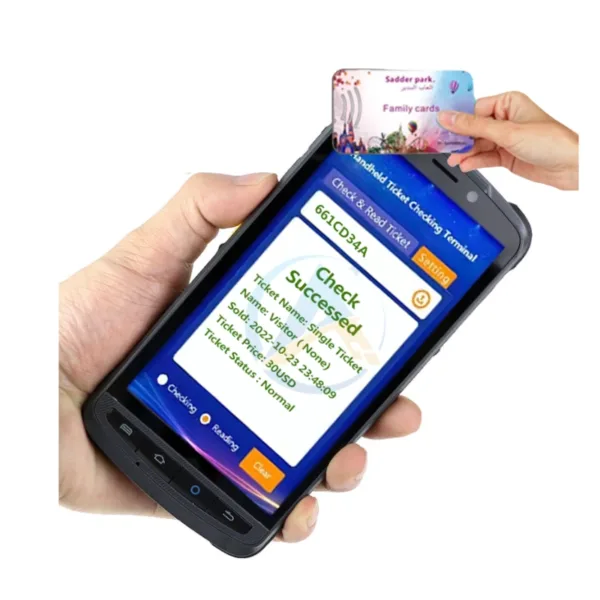
An integrated ticketing system helps amusement parks manage ticket issuance and visitor verification without relying on separate devices for every task. When printing, RFID encoding, and QR code scanning operate through disconnected equipment, staff may face slower workflows, additional maintenance requirements, and more complicated system integration.
ZAH Ticketing addresses these challenges with an integrated printer RFID QR code scanner designed for park ticketing and access control applications. The device combines three functions in one compact unit, helping your team issue tickets, encode RFID credentials, and verify QR codes at service counters and entrance points. Backed by Shenzhen ZAH Intelligent Equipment Co., Ltd.’s experience in ticketing solutions, this hardware can support a more connected visitor management workflow.
What Is an Integrated Ticketing System?
An integrated ticketing system connects ticket issuance, credential verification, and access management within a coordinated operating environment. Depending on your configuration, it can combine ticketing software, ticket printers, RFID readers, QR scanners, POS terminals, and entrance control equipment.
For parks and attractions, the integrated printer RFID QR code scanner serves as a hardware component within this environment. It prepares physical tickets or compatible credentials and reads digital or printed codes, while the connected software determines ticket validity and access permissions.
The main functions include:
- Thermal ticket printing: Produces physical tickets at service counters or ticketing stations.
- RFID encoding: Writes compatible credentials to supported RFID media.
- QR code scanning: Reads QR codes, Data Matrix codes, and supported barcodes.
- System connectivity: Provides network and serial interfaces for integration with compatible ticketing and access control platforms.
Key Features of ZAH Ticketing Hardware
1. Combined Printing, RFID Encoding, and QR Scanning
Instead of deploying three separate devices, you can use one unit for ticket preparation and credential verification. This configuration can simplify counter layouts and reduce the number of separate hardware components your team needs to maintain.
The specified direct-thermal printing speed is 4 inches per second, with a resolution of 203 DPI and an automatic cutter. These specifications support routine ticket production, although actual throughput depends on ticket length, system processing, and operating conditions.
2. RFID Encoding and Multi-Code Recognition
The integrated RFID module supports HF 13.56 MHz technology and the specified MIFARE Classic and DESFire formats. Its stated read/write distance is 50 mm, making it suitable for compatible card or credential encoding workflows.
The 2 MP CMOS scanner reads QR codes, Data Matrix codes, and barcodes at a stated distance of 5–45 cm, with recognition in approximately 0.3 seconds under suitable conditions. Actual results vary with code quality, lighting, and scanning angle.
3. Flexible Connectivity and System Integration
The device offers dual Ethernet interfaces, USB 3.0, RS-232, and an optional Wi-Fi 6 module. A RESTful JSON API is specified for integration with compatible access control systems.
ZAH Ticketing also develops its own ticketing software and hardware and reports more than 1,000 successful projects internationally. This experience provides relevant background when evaluating a supplier for a broader integrated ticketing system. However, you should confirm protocol compatibility, API documentation, and supported software functions before deployment.
Technical Specifications at a Glance
| Feature | Specification |
|---|---|
| Printing | Direct thermal, 4 inches/second |
| Resolution | 203 DPI |
| RFID | HF 13.56 MHz; MIFARE Classic/DESFire |
| RFID distance | 50 mm stated read/write distance |
| Scanner | 2 MP CMOS |
| Recognition | Approximately 0.3 seconds stated |
| Media | 80 mm paper roll |
| Interfaces | Dual Ethernet, USB 3.0, RS-232; optional Wi-Fi 6 |
| Processor | Quad-core 1.6 GHz, 2 GB RAM |
| Operating system | Linux |
| Dimensions | 280 × 180 × 150 mm |
| API | RESTful JSON API |
The listed specifications are manufacturer-provided and should be confirmed against the final product configuration before purchase.
Where Can You Use an Integrated Ticketing Device?
An integrated ticketing device can support several operational scenarios:
- Amusement and theme parks: Prepare tickets and encode access credentials at admission counters.
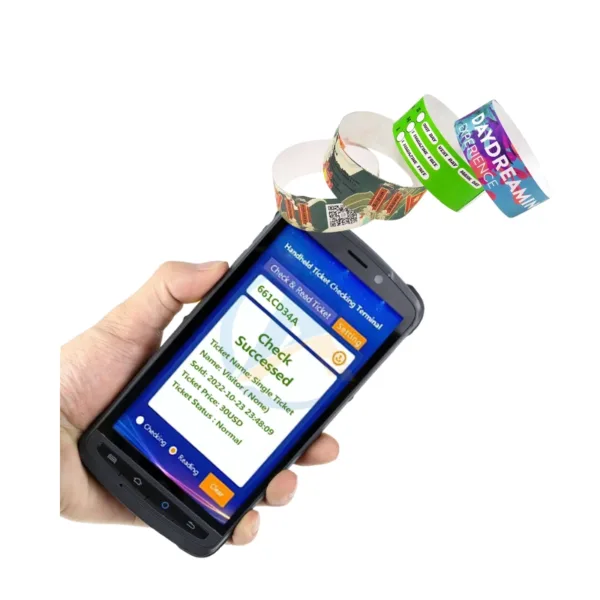
- Water parks: Issue compatible RFID wristbands or cards when the media format and encoding workflow are supported.
- Museums and exhibitions: Print admission tickets and scan QR codes for visitor verification.
- Membership service desks: Encode compatible membership credentials and print supporting ticket information.
- Centralized service counters: Handle ticket replacements, upgrades, and special-access issuance through connected software.
For example, a water park can issue an RFID wristband at its ticket counter, then use compatible readers at designated entrances. The integrated printer handles credential preparation; the wider ticketing platform and access control equipment manage validation and entry decisions.
Integrated Ticketing Hardware vs. Separate Devices
| Comparison | Integrated Device | Separate Devices |
|---|---|---|
| Hardware setup | Printing, encoding, and scanning in one unit | Multiple individual units |
| Counter space | Potentially lower footprint | More space may be required |
| Maintenance | Modular replacement is specified | Each device is maintained separately |
| Integration | Fewer hardware components to coordinate | Multiple interfaces may need configuration |
| Expansion | Suitable for combined service stations | Individual functions can be expanded independently |
An integrated device is worth considering when you want to simplify ticket counter operations. Separate devices may offer more flexibility if your park requires specialized printers, high-volume scanning stations, or different RFID technologies across multiple locations.
How to Integrate the Device Into Your Ticketing Workflow
Follow these steps when planning deployment:
- Define your ticketing requirements. Identify whether you need paper tickets, RFID cards, wristbands, QR codes, or a combination.
- Check media compatibility. Confirm RFID frequency, supported chip formats, ticket dimensions, and barcode requirements.
- Connect the hardware. Select Ethernet, USB, RS-232, or the optional wireless connection according to your system architecture.
- Configure software integration. Test the API, ticket records, encoding commands, and scanner data exchange with your existing platform.
- Run end-to-end tests. Verify ticket issuance, credential encoding, QR recognition, access decisions, and error handling before opening to visitors.
- Train staff and plan maintenance. Establish procedures for paper replenishment, module replacement, troubleshooting, and software updates.
Frequently Asked Questions
Can this device work with an existing integrated ticketing system?
Potentially, yes. It provides multiple connectivity options and a RESTful JSON API, but compatibility depends on your existing software, communication protocols, and integration requirements. Request a technical compatibility review before ordering.
Does the device support RFID wristbands?
It supports the specified HF 13.56 MHz RFID technology and MIFARE Classic/DESFire formats. Confirm that your wristbands use compatible chips and that the required encoding functions are supported.
What certifications does ZAH Ticketing hold?
ZAH reports relevant software copyrights, patents, and international certifications including ISO, CE, and RoHS. Ask the company for the applicable certificates and their scope to verify whether they cover the specific hardware model you intend to purchase.
Conclusion
Choosing an integrated ticketing system involves more than selecting a printer or scanner. You need compatible hardware, reliable credential handling, and a clear integration path for your existing ticketing and access control software. ZAH Ticketing’s integrated printer RFID QR code scanner combines three essential functions in one device, offering a practical option for parks, museums, and other visitor attractions seeking to simplify ticket issuance and verification.
Request a Technical Consultation
Contact Shenzhen ZAH Intelligent Equipment Co., Ltd. to discuss your ticket formats, RFID requirements, scanner interfaces, and software compatibility. Share your expected ticket volume and deployment environment to help the team assess a suitable configuration.

Add comment