
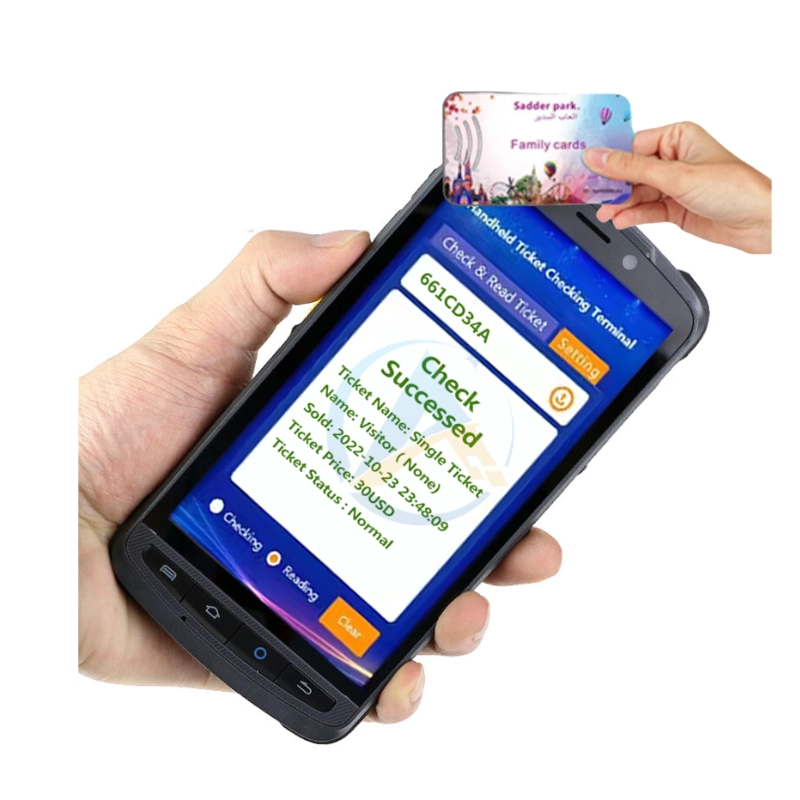
When you issue RFID tickets, you need more than a card or chip encoder. You need a reliable way to print tickets, encode access credentials, scan QR codes, and verify visitors without creating separate operational steps. For parks, museums, attractions, and large venues, disconnected devices can slow entry and increase maintenance work. ZAH Ticketing addresses this challenge with an integrated printer, RFID encoder, and QR code scanner in one compact terminal. The device supports RFID ticket issuance, QR verification, membership card production, and access control integration. With 12+ years of development experience and more than 1,000 overseas projects, Shenzhen ZAH Intelligent Equipment Co., Ltd. provides a practical hardware solution for operators seeking faster and more unified ticketing workflows.
Why RFID Tickets Matter for Park Ticketing
RFID tickets allow you to combine contactless identification with controlled admission. Instead of relying only on printed information, you can encode visitor credentials into an RFID chip and use QR codes as an additional verification method.
For high-traffic attractions, this approach can simplify ticket issuance and improve the connection between ticketing and access control. It also supports different visitor scenarios, including one-time admission, memberships, upgrades, replacements, and special-access tickets.
The integrated ZAH device combines three functions:
- Direct-thermal ticket printing at up to 4 inches per second
- HF RFID encoding at 13.56 MHz for MIFARE Classic and DESFire
- QR, Data Matrix, and barcode scanning through a 2MP CMOS sensor
- 80 mm paper roll capacity with paper-out and jam detection
- RESTful JSON API for access control system integration
- Ethernet, USB 3.0, RS-232, and optional Wi-Fi 6 connectivity
Integrated RFID Tickets for Access Control
A major advantage of this solution is that you do not need separate equipment for every verification task. The printer, RFID module, and scanner operate through a unified processing architecture, allowing you to issue and verify tickets through a coordinated workflow.
The RFID module provides a 50 mm read/write distance, while the imaging scanner recognizes QR codes and barcodes from approximately 5–45 cm with recognition in about 0.3 seconds. Therefore, you can support both RFID-based and QR-based entry processes from the same terminal.
RFID Ticket Printing and Encoding
For on-demand ticket issuance, the device prints the physical ticket and encodes its RFID credentials during the same workflow. This is useful when you need to issue admission tickets at ticket counters, information centers, or service desks.
You can also use the terminal for RFID membership cards. Membership privileges can be stored on supported RFID cards while QR codes provide an additional identification method.
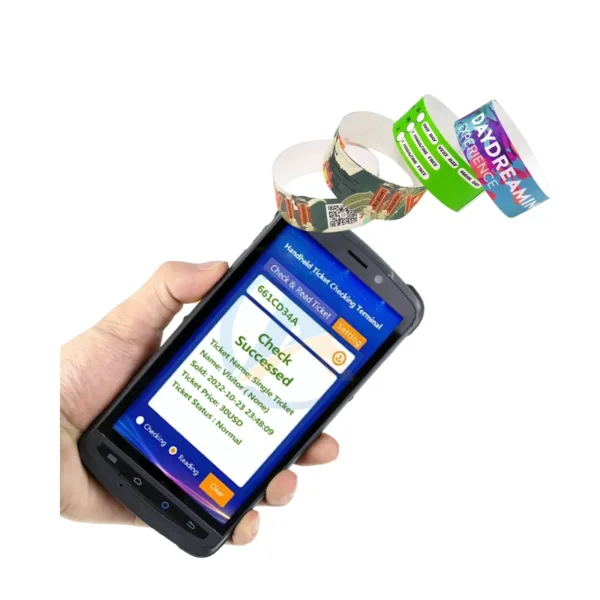
QR Code Scanning for Visitor Verification
QR codes remain useful for online bookings, digital tickets, and backup verification. The integrated scanner supports QR, Data Matrix, and barcode recognition, allowing you to handle multiple ticket formats without adding a separate scanning terminal.
This makes the system suitable for attractions that combine online reservations with physical ticket issuance and RFID-based access control.
RFID Tickets vs. Separate Ticketing Devices
Choosing an integrated terminal depends on your operational requirements. The following comparison shows where this solution can provide practical advantages.
| Feature | Integrated RFID Ticket Terminal | Separate Devices |
|---|---|---|
| Ticket printing | Built in | Requires printer |
| RFID encoding | Built in | Requires RFID encoder |
| QR scanning | Built in | Requires scanner |
| System integration | RESTful JSON API | Depends on each device |
| Maintenance | Modular components | Multiple devices |
| Counter footprint | Compact | Larger |
| Ticket + RFID workflow | Unified | Multiple steps |
| Access control support | Designed for integration | Requires integration between devices |
For a busy attraction, reducing device handoffs can make the ticketing process easier for staff. Moreover, the modular design allows the printing, RFID encoding, or scanning module to be replaced independently, which can help reduce maintenance downtime.
How to Deploy an RFID Ticketing Workflow
You can implement the integrated terminal through a straightforward operational process:
- Connect the terminal to your ticketing system using Ethernet, USB, RS-232, or the RESTful JSON API.
- Create the visitor ticket or membership record according to your admission rules.
- Print the physical ticket using the 203 DPI direct-thermal printer.
- Encode the RFID credential onto a compatible 13.56 MHz RFID chip.
- Add or verify the QR code for alternative identification and redemption.
- Connect the credential to your access control system for entrance validation.
- Use the same workflow for replacements, upgrades, and special-access tickets.
This workflow can help you connect ticket issuance with downstream access control instead of treating each operation as a separate process.
Where RFID Tickets Work Best
The integrated printer and scanner can support several real-world attraction scenarios:
- Amusement parks: Issue RFID admission tickets and verify visitors at entrances.
- Water parks: Combine contactless credentials with QR-based ticket verification.
- Museums: Produce advance-booking tickets and membership cards at service counters.
- Zoos and wildlife parks: Support high-volume admission and ticket replacement.
- Large events: Issue temporary access credentials and scan QR-based registrations.
- Membership centers: Encode privileges onto RFID cards and maintain QR backups.
- Central service centers: Handle ticket upgrades, replacements, and special-access issuance.
ZAH Ticketing has deployed its solutions across more than 1,000 overseas projects, with project experience spanning Asia, Africa, Europe, the Americas, and Oceania. This international deployment experience supports applications where multilingual operation and integration flexibility matter.
ZAH Ticketing: Hardware and Software Integration
ZAH Ticketing develops both proprietary software and self-developed ticketing hardware. Its platform includes ticketing and online booking, access control, POS and kiosks, locker management, and car park management.
The company reports 20+ software patents and 6+ hardware patents, alongside ISO, CE, and RoHS-related certifications. Its systems also provide multilingual support, real-time analytics, open API integration, and 24/7 technical support.
For operators evaluating an RFID ticketing system, this combination is important because hardware performance alone does not determine the quality of the final deployment. You also need compatible software, stable interfaces, maintenance support, and a scalable architecture.
FAQ
1. What are RFID tickets used for?
RFID tickets store visitor or access credentials on an RFID chip. You can use them for admission, memberships, prepaid access, and other controlled-entry applications.
2. Can RFID tickets also use QR codes?
Yes. The ZAH integrated terminal can encode RFID credentials while scanning QR codes, allowing you to support RFID and QR-based verification within the same ticketing workflow.
3. Can the RFID ticket printer integrate with existing systems?
Yes. The device provides a RESTful JSON API and supports Ethernet, USB 3.0, and RS-232 connectivity, allowing integration with compatible ticketing and access control systems.
Conclusion
When you need RFID tickets for an attraction, combining printing, RFID encoding, and QR scanning can simplify ticket issuance and access verification. ZAH Ticketing’s integrated terminal supports 13.56 MHz RFID encoding, 203 DPI thermal printing, multi-format code scanning, and RESTful API integration in one compact device. With more than 12 years of development experience and 1,000+ overseas projects, ZAH can support operators looking to build a connected ticketing and access control workflow.
CAT
If you are planning an RFID ticketing deployment, contact ZAH Ticketing with your venue type, ticket format, RFID card requirements, expected visitor volume, and existing access control system. ZAH can help you evaluate the appropriate hardware configuration and integration approach.



Add comment